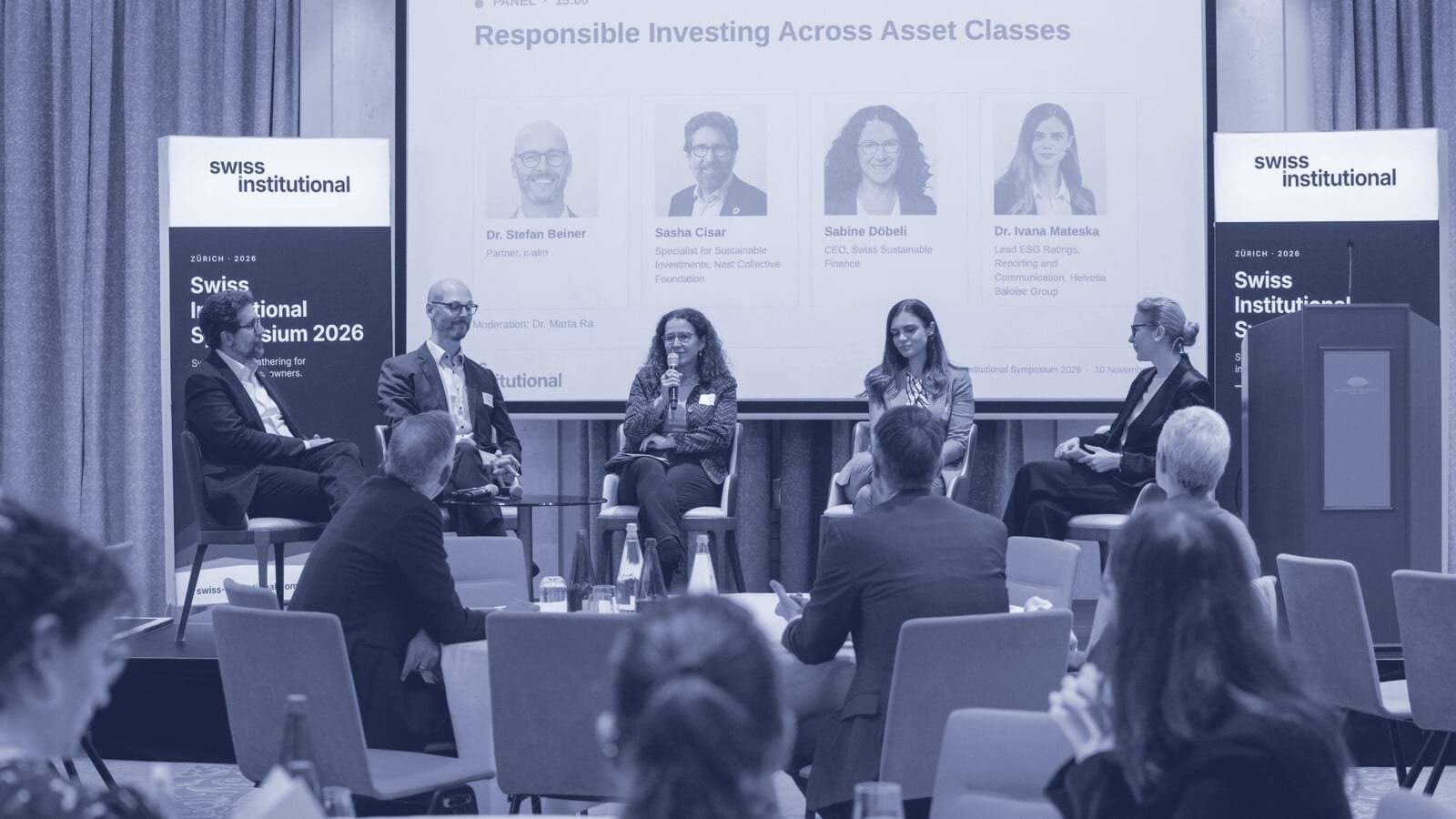
Panellists: Sabine Döbeli (CEO, Swiss Sustainable Finance), Sasha Cisar (Specialist for Sustainable Investments, Nest Sammelstiftung), Dr Stefan Beiner (Partner, c-alm) and Dr Ivana Mateska (Lead ESG Ratings, Reporting and Communication, Helvetia Baloise Group). Moderator: Dr Marta Ra.
The position of Swiss pension funds
Sabine Döbeli, CEO of Swiss Sustainable Finance (SSF), drew on SSF's annual market study. Approximately CHF 1.9 trillion is managed under one or more sustainable investment approaches, some 60% of it on behalf of institutional clients, either directly by large pension funds or through mandates and funds. Whether all of it is genuinely sustainable is a question SSF debates with its members each year. A considerable proportion of fund assets, and a still larger proportion of mandates, is not marketed as sustainable. These are mainstream assets that integrate ESG factors into the investment process.
For asset owners, she stated, sustainability means above all integration: into day-to-day investment decisions, into the selection of asset managers and products, and into reporting across all assets, whether a green bond or a conventional one. It is a matter of risk management, and a growing number of asset owners act accordingly.
Strictly speaking, Döbeli observed, Swiss pension funds are subject to no self-regulation, merely to a recommendation from ASIP. In the most recent survey, conducted by PwC, approximately half of the participating funds report under the ASIP standard, and adoption is rising markedly. She nonetheless sees scope for improvement in the quality of disclosure, notably on quantitative indicators and substantive information on stewardship. The more significant gap lies in the foundations: according to Swisscanto's pension fund study, only about a third of funds have incorporated a sustainability policy into their investment regulations. It is precisely such a policy that enables a fund to set requirements when selecting and monitoring asset managers.
The case for impact
Nest Sammelstiftung has invested according to ecological and ethical principles since 1983. Sasha Cisar, Specialist for Sustainable Investments at Nest, traced its progression from an ethical conviction, through environmental and social criteria, to a comprehensive sustainable approach across the entire portfolio. Today Nest poses an additional question: not only how the world affects the portfolio, but how the portfolio affects the world. ESG integration and exclusions remain important, yet they present only part of the picture.
Impact goes a step further, asking how investments contribute to positive change and finance solutions to address specific sustainability challenges. This is particularly relevant to pension funds, given their long investment horizons, since they help to shape the world into which their members will retire. "A financially secure pension in an unliveable world is, in my view, not a successful outcome," Cisar said. Nest estimates that a significant proportion of its portfolio already generates positive impact and is developing a comprehensive impact perspective across its portfolio.
At Building Bridges in Geneva, Nest Sammelstiftung introduced to Switzerland the Dutch debate on a 10% impact allocation. In the Netherlands, asset owners and asset managers have committed to such a share. Cisar hopes to move the conversation forward in Switzerland.
Three objectives, different effects
Dr Stefan Beiner, Partner at c-alm, proposed a distinction that framed much of the subsequent discussion. First, the management of sustainability risks, which he regards as part of an asset owner's fiduciary duty. Second, making the portfolio appear more sustainable. Third, real-world impact, that is, impact investing in the narrower sense. Recent academic research demonstrates that the available mechanisms vary considerably in their effectiveness for institutional investors. Beiner examined four areas:
- Listed equities: ESG integration and tilts, exclusions and engagement. The evidence favours engagement, that is, an attempt to influence strategy at board level, which for an individual pension fund is generally feasible only in concert with other asset owners. On current evidence, exclusions raise the cost of capital of the companies concerned only marginally and are therefore of limited effect from an impact perspective.
- Bonds: There are sound reasons to hold green bonds. In terms of impact, however, Beiner questions whether the projects concerned would not have been financed in any event. Additionality is low.
- Real estate and real assets: This is where Beiner sees the greatest scope. The owner of a building can improve its energy efficiency, replace the heating system and thereby reduce CO2 emissions, while continuing to earn attractive returns.
- Microfinance: Socially attractive, as it promotes financial inclusion. A c-alm study indicates a moderate expected return, comparable to that of investment-grade bonds, but a highly stable return stream capable of improving a portfolio's risk-return profile.
Where should a board of trustees with limited resources begin? Beiner would start with engagement in listed equities, concentrating on a small number of the worst-performing companies, where change would have the greatest effect. Second would come reduction pathways for directly held real estate. He would be cautious about awarding a broad, general impact mandate. A fund cannot pursue all 17 Sustainable Development Goals, he said; it must prioritise its themes and determine which mechanism is appropriate for each.
ALM first, then the question of impact
Can an impact allocation satisfy the requirements of security, adequate return and diversification? For pension funds it must, Beiner said. Not all impact investments deliver market returns, but the overlap between market-rate investing and impact investing is by no means empty. The starting point remains the ALM study, which on the empirical evidence determines 80% to 90% of returns: liabilities and expected cash flows, risk capacity and risk tolerance, the required return and liquidity constraints together determine the strategic asset allocation. Only at the second stage, when the individual building blocks are implemented, should the question be put as to where impact investing is appropriate and where it is not. To begin with a 5% or 10% commitment is not sensible for most asset owners. Those with long experience, who know where market returns are attainable, are able to form realistic assumptions for the portfolio as a whole.
Cisar generally agrees with this sequence. For Nest Sammelstiftung, too, real estate and real assets offer the most tangible and far-reaching impact, particularly directly held properties, where the fund controls the levers itself. Stewardship constitutes a second major set of instruments. Nest Sammelstiftung participates in collaborative engagement pools, has added direct engagements and exercises its voting rights. In listed equities and bonds the achievable impact is less profound, but it is achievable. Together with ETH Zurich, Cisar is conducting a research project that synthesizes the academic literature on achieving impact in public markets. The resulting investor playbook is due at the end of 2026 or in early 2027 and is intended to show both newcomers and experienced investors what is regarded as credible impact.
An example from its own strategy: at the end of 2025 Nest Sammelstiftung revised its strategic asset allocation and increased its infrastructure allocation, explicitly with impact in view. The principal driver of returns, however, remains the share of riskier assets in the asset allocation, such as equities, irrespective of whether a fund invests sustainably.
Engagement from an insurer's perspective
Insurers are major institutional investors, but their portfolios are dominated by bonds, which confer no voting rights. For Dr Ivana Mateska, Lead ESG Ratings, Reporting and Communication at Helvetia Baloise Group, engagement is therefore the central instrument of active ownership. It can exert pressure on ESG matters, but it can equally support companies in their transition towards greater sustainability. Depending on the subject, its priority and the resources available, the former Baloise employed three forms: direct engagement with individual companies; collaborative engagement through platforms and initiatives such as the PRI, Spring, Climate Action 100+ and Advance; and engagement through a specialised third-party provider, for instance on biodiversity, gender equality and norms-based cases involving breaches of sustainability standards. In 2025 the former Baloise alone supported more than 110 collaborative engagements.
Mateska demonstrated how individual engagements can generate broader impact. Over four years of direct engagement, Baloise approached 13 companies, nine of them banks or other financial institutions, predominantly cantonal banks. Eight of the financial institutions accepted. The trigger in each case was a weak MSCI ESG rating, MSCI being Baloise's principal source of ESG data. Over time it became evident that the institutions scored well or poorly on the same indicators and raised similar questions. Baloise therefore brought in MSCI, which provided several banking-sector specialists, and invited all cantonal banks, not only those with which it was engaged, to a briefing on the rating methodology. In this way no names were disclosed, and the effect extended beyond its own engagements. Seventeen of the 24 cantonal banks attended. Subsequently, two banks with which Baloise had not engaged approached it to request an engagement.
Disclose impact rather than reduce it to a single figure
Should the ASIP standard incorporate impact indicators, or would that invite "impact-washing"? Impact across asset classes cannot be captured in a single indicator, Döbeli said. An SSF study on impact reporting, published in January 2026, distinguishes between two dimensions. A pension fund or asset manager must first state what its strategy is intended to achieve, setting out its theory of change, and then demonstrate what it has in fact achieved. For stewardship, this means disclosing how it voted, how often it voted against proposals and on what grounds, and providing examples of both successful and unsuccessful engagements. She cited the Swiss Association for Responsible Investments (SVVK-ASIR), which has introduced a further escalation stage: where engagement fails, newly issued bonds of the company concerned are no longer purchased. That, too, constitutes a form of impact.
For impact investing in the narrower sense, for instance in private markets or emerging economies, highly specific indicators are required for each concrete objective. These cannot be aggregated across portfolios, but they can be substantiated with examples. What matters is transparency about what one intends to achieve and whether one delivers on that commitment. The same applies to asset managers; in the self-regulation of the Asset Management Association Switzerland (AMAS), it is an integral component of sustainable investments.
What should change in 2027
In the concluding round, each panellist named one thing that pension funds and insurers should do differently in 2027:
- Ivana Mateska: Reposition the focus of engagement policies. At present the emphasis lies on activity counts: companies engaged, cases addressed, meetings held, emails sent. What is required are outcomes, which may not always be quantifiable but should be measurable.
- Sabine Döbeli: The 62% of funds without an anchored sustainability policy should adopt one and integrate its criteria into the selection and monitoring of asset managers. This is a matter of fiduciary duty. The hot summer in Switzerland demonstrated how climate effects bear upon economic activity and, consequently, upon pension fund portfolios.
- Stefan Beiner: Approach sustainability with less emotion, rather than simply being for or against it. And ask more frequently how one's investments alter the real world, for better or for worse.
- Sasha Cisar: Ask how your portfolio affects the world, and act accordingly. If a 10% impact allocation appears substantial, consider the remaining 90%, which may also have a negative impact.
Question from the audience
The indicators in the ASIP standard cover only listed equities and bonds, whereas impact investments are frequently located in private markets. Can the standard be extended?
Döbeli acknowledged that the current indicators are limited and apply principally to listed equities and corporate bonds. One way forward would be a broader set from which funds select according to their portfolio. Beiner pointed to progress in Swiss real estate, where REIDA provides a sound basis for comparison, and to GRESB for international real estate and infrastructure. Each asset class requires its own indicators. Cisar added that many indicators already exist; in private markets and real assets the question is chiefly how to obtain the data. Nest uses the SSF real estate questionnaire for its indirect real estate portfolio and achieved a 97% response rate. For private equity and infrastructure, some data points are still lacking. His advice: begin with public markets, where the data is available.
Conclusion
The panel shifted the debate from whether pension funds should invest sustainably to what their measures in fact achieve. The answers were sober: integration and reporting constitute the foundation and a fiduciary duty; real-world impact arises principally in directly owned real estate and through engagement; and an impact allocation must withstand the tests of security, return and diversification. What united all four panellists was the demand for outcomes rather than activity. Or, as Cisar put it, the objective is good pensions in a liveable world.
Further reading on Swiss Institutional: Responsible Investing Is Decided Asset Class by Asset Class, Stewardship Is Not a Policy Document. It Is a Discipline. and Microfinance for Swiss Institutional Investors
This summary is based on the panel "Responsible Investing Across Asset Classes" at the Swiss Institutional Symposium 2026, Mandarin Oriental Savoy, Zurich, on 10 November 2026. Moderator: Dr Marta Ra. This article does not constitute investment advice.