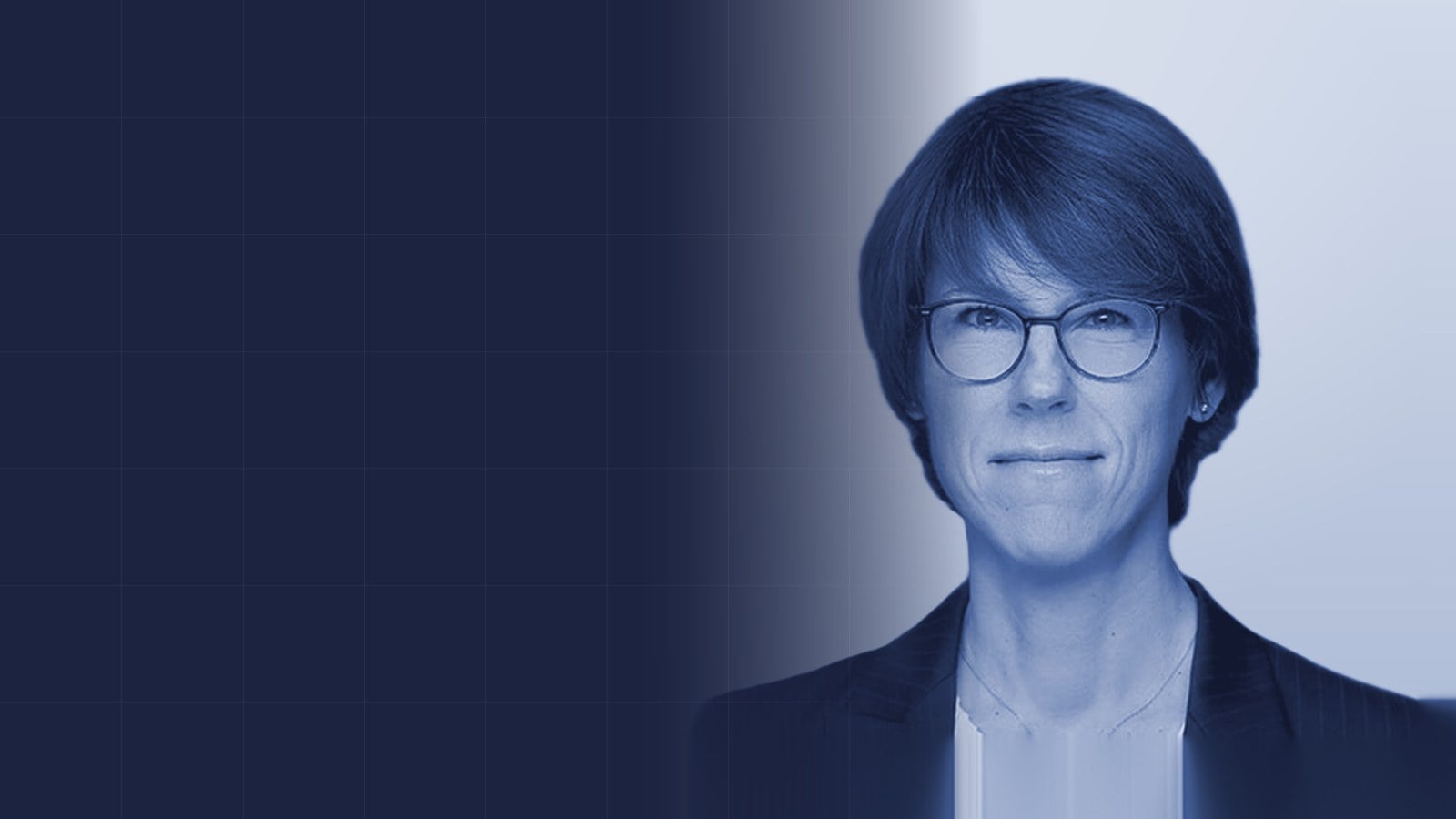
Dr. Christel Rendu de Lint has served as Co-CEO of Vontobel since 2024, having joined the firm as Deputy Head of Investments in May 2021. She was previously Head of Fixed Income at Union Bancaire Privée (UBP) and, before that, a senior fixed income portfolio manager at Pictet. She began her career at Morgan Stanley in London in 2000. She holds a PhD in Economics from London Business School and a master’s degree from the University of St Gallen (HSG).
The conversation took place on 10 November 2026 at the Mandarin Oriental, Zurich, and was moderated by Dr. Marta Ra, Co-founder of Swiss Institutional. It has been edited for length and clarity. Questions are by Dr. Marta Ra unless otherwise indicated.
Markets
Long-term yields have risen markedly in the United States and Europe, and France now pays a wider spread over Germany than Italy does. Conventional theory holds that when the risk-free rate rises, capital leaves equities. Yet equity markets stood close to record highs. How do you interpret this? Is the market under-pricing risk, or has the relationship itself changed?
Christel Rendu de Lint: The question is whether the correlation between equities and bonds has gone wrong. One could argue that it has, but I do not see it that way. What we are observing is the product of several forces. First, monetary policy is not restrictive at present, so it is not cooling markets. Second, and probably more significant, we have a powerful structural trend in AI that has powered and turbocharged the market.
Rates are rising because the economy has proved remarkably resilient despite every shock it has had to absorb, and it has been resilient partly because AI investment is real and is being deployed in the real economy. That is not a judgement on whether it is correctly priced. As a matter of fact, the investment has been substantial and has supported growth, while central banks have struggled to bring down the inflation that accumulated after the pandemic.
The reason I maintain that the correlation is intact is simple. If the Fed were to announce tomorrow, “Enough of this inflation, we are hiking by 100 basis points”, I can assure you the equity markets would take note.
Setting that scenario aside, what has changed structurally, and what is merely cyclical?
Christel Rendu de Lint: For now, the structural element is AI. But it is structural in a sense that may not endure to the same extent. The investment comes first, then the take-off, and then it must translate into the real economy. It cannot be AI for the sake of AI. So part of it is structural, but the slope of that structural impetus is likely to begin flattening and broadening out.
“If the Fed were to announce tomorrow, ‘Enough of this inflation, we are hiking by 100 basis points’, I can assure you the equity markets would take note.”
– Christel Rendu de Lint
Bonds and the Swiss franc
You have long made the case for the return of the balanced portfolio. For a Swiss fund confronting low franc yields and a minimum interest rate to credit, how much work can bonds genuinely do today?
Christel Rendu de Lint: I would not say I was making the case for it. In 2022, rates rose to cool the economy and bring inflation down, and the mechanism behaved exactly as it should: you raise rates, you cool growth assets, and for a period both fall together. That is acutely painful for portfolios, and it was one of the most painful episodes in a century because rates started from zero. But in my view it never meant that the balanced portfolio was dead. There will always be phases in which rates are raised to cool the economy; that is deliberate. Unless you time your entry and exit in both perfectly, you have to go through that period. And it is unlikely to be as brutal again, because bonds now pay income.
Switzerland remains a difficult market, of course, because interest rates are very low, for better or worse. That makes investing harder, but it also reflects low deficits and low inflation. The low deficit is unambiguously positive. On inflation, one hopes we do not drift towards levels that are too low, since somewhat higher rates and a little more inflation are more comfortable. But so be it, and there remains room to invest in fixed income. Without question.
Comparing domestic franc bonds with hedged global bonds, how should a fund weigh hedging costs against yield?
Christel Rendu de Lint: This is a personal conviction, and one I have held since working with pension funds on fixed income mandates: anything you do in fixed income outside Swiss franc bonds should be hedged. Exchange-rate volatility is far greater than the expected return of the underlying asset class. So, as a matter of principle, I would hedge.
Because Switzerland carries little debt, its fixed income market offers limited choice, and international bonds open up other segments. Yes, if US high yield pays 8%, that becomes roughly 4% in Swiss francs. That is the reality. But we also have lower inflation. If inflation is 4% in the US and zero in Switzerland, the return after inflation is the same. It is a matter of perspective.
“Any fixed income you do outside Swiss franc bonds should be hedged. Exchange-rate volatility is far greater than the expected return of the underlying asset class.”
– Christel Rendu de Lint
Liquidity and the total portfolio
You have said that your guiding principle as an allocator was never to be caught out on liquidity. During the symposium we heard the case for private markets. How should an investment committee set its liquidity budget?
Christel Rendu de Lint: It is not that I object to illiquid assets. I have simply seen it too often: less liquid assets in daily liquidity vehicles have led to too many failures in asset management. That is my point.
For institutions with a long-term horizon, private markets make a great deal of sense, because they add a further investment universe, much as international bonds do. But if an asset is illiquid, it is illiquid. Can you carry it, yes or no? If you cannot, do not.
Most Swiss foundation boards consist of employer and employee representatives with limited time. Is the total portfolio approach realistic for them, or only for large funds?
Christel Rendu de Lint: That depends on the implementation. But the short answer is yes, it makes sense, because the total portfolio approach essentially means asking: have I built the right portfolio for what I am trying to achieve? That must be the question, though it is not an easy one to answer. In my experience, asset allocation decisions are greatly underrated. They are what drives long-term performance: how much you hold in risk assets, and how much in diversifying assets. It is fundamentally the right approach.
What do asset owners ask of managers today that they did not ask five years ago?
Christel Rendu de Lint: The subject that has come up far more often this year, around the world, is diversification. It should always be on the agenda, but it was easy to neglect under QE, and now under AI. So I welcome the question. It is, in essence, a question of resilience. It is not merely about the weighting of one segment against another; it is about ensuring that the risk drivers in your portfolio are genuinely different. If you own US equities, US venture capital and investment grade tech bonds, the same theme runs through all of them. It looks diversified, but it will not be.
“If you own US equities, US venture capital and investment grade tech bonds, the same theme runs through all of them. It looks diversified, but it will not be.”
– Christel Rendu de Lint
The franc and the dollar
With the global investment map fragmenting, is the Swiss home bias in pension portfolios a risk to be reduced or a hedge to be retained?
Christel Rendu de Lint: That brings us back to the total portfolio approach. You know what you must achieve, and a Swiss pension fund must achieve its return in Swiss francs. The home bias should be the outcome of having assessed everything else: if other asset classes offer no advantage over Swiss ones, it probably makes sense to remain in Swiss francs, since that involves less complexity than hedging.
For all of us, the Swiss franc is both a blessing and a curse. It is one of the few safe havens left. But whenever you translate a return back into Swiss francs, it is hard to beat, genuinely hard to beat. So I am not dogmatic about portfolio construction. The questions for adding any particular segment are these: Is it diversifying? Does it help me achieve what I must achieve?
How should a franc-based investor approach US dollar exposure today?
Christel Rendu de Lint: Your return has to be delivered in Swiss francs, so hold dollar exposure if you want it. In some asset classes, private markets for example, hedging is genuinely impractical. That has to be taken into account: am I confident that what I am investing in will still make sense once translated into francs? Moving into dollars, or into euros for that matter, should be an active decision, not an accidental exposure.
Questions from the audience
You suggested that various equity and private equity products may not be diversifying. Which asset classes do you favour for diversification – hedge funds, insurance-linked securities?
Christel Rendu de Lint: I said they might not be diversifying. If you have bought private equity that invests in data centres and the S&P corrects tomorrow, you may not see it in the NAV immediately, but it will of course be affected. If your private equity sits in an entirely different segment, it will be diversifying, although it remains a risk asset. Commodities can diversify, as can inflation-linked assets and, in particular, infrastructure, provided you are not going into data centres. Brownfield infrastructure enjoys powerful macro tailwinds; look around you, from airports onwards, investment will be required. These investments are not cyclical and are very often inflation-linked.
The point is that you must work through the portfolio, because you may end up with the same exposure across different asset classes. Not long ago, tech companies issued relatively little debt. I remember Apple’s first big deal. Today tech accounts for around 10% of the US investment grade index. So I would be selective about where I take exposure to that particular theme, which is now ubiquitous.
Artificial intelligence
Over the next decade, how will the skills profile of an investment committee need to change, and what role will AI play?
Christel Rendu de Lint: I am not convinced the skills will need to change fundamentally. The most important have always been asking the right questions, exercising judgement and pushing yourself beyond your comfort zone. Many people dislike asking: What might I be missing? What could go wrong? What have I not asked? That is a daily discipline. As an active manager, which I have been throughout my career, every time you leave a position unchanged when you could have altered it, you are endorsing it afresh. That question never ends.
What AI provides is information at scale, but the same information for everyone. You can ask it what to do and it will give you an answer, but that is not sufficient. It is rather like the cameras on iPhones: they are exceptional, but they have not made all of us great photographers. I wish they had in my case! AI will outperform the worst investment committees and the worst active managers, who often do worse than chance in any case. It raises the floor. But it will not outperform anyone who has taken the data, applied judgement and ensured that the investments match the objectives and the targeted outcome, which are highly specific. So judgement and curiosity are the essential skills.
“AI will outperform the worst investment committees. It raises the floor. But it will not outperform anyone who has applied judgement.”
– Christel Rendu de Lint
Personally, I am rather bearish on AI, and frankly relieved that our pension fund does not necessarily hold exposure to all the hyperscalers. Do you see a correction coming, given the circular financing, the postponed IPOs and an infrastructure build-out that is running ahead of proven use cases?
Christel Rendu de Lint: All one can say is that, rightly or wrongly, the market is remarkably robust, and so is the theme. It has already had ample reason to correct, from rising interest rates to a war. The investments are real. Part of it may be retail flows, which have played a large role in stock market performance. They have been conditioned to buy the dips, and for years that has been the right call.
So a correction requires a trigger. That may sound simplistic, but in my experience valuation alone is not enough; assets can look expensive for a very long time. Coming from fixed income: no one could imagine that rates would turn negative. There has to be a trigger, and so far there has been none. Companies continue to report good results, and the theme is resilient. So, as far as I can judge, it is not imminent, but it could happen tomorrow. A major event is always possible, and that, of course, is where the large positions lie.
The best outcome would be a soft landing, in which other industries come forward with use cases and say, “This has changed the way we operate”, so that pure AI exposure deflates and the gains migrate into the wider economy. Admittedly, it rarely unfolds that way. It is a difficult call. I am not evading the question; I simply do not know.
For 2027
If you were to give one recommendation to a Swiss pension fund board at its first investment committee meeting of 2027, what would it be?
Christel Rendu de Lint: “Do I have the right allocation? Do I have the right allocation?”
About the Symposium
The Swiss Institutional Symposium 2026 was held on 10 November 2026 at the Mandarin Oriental, Zurich. The inaugural edition convened a select audience of Swiss pension funds, insurers, foundations and family offices for a single-track programme covering fixed income, private markets, sustainability, regulation and venture capital.