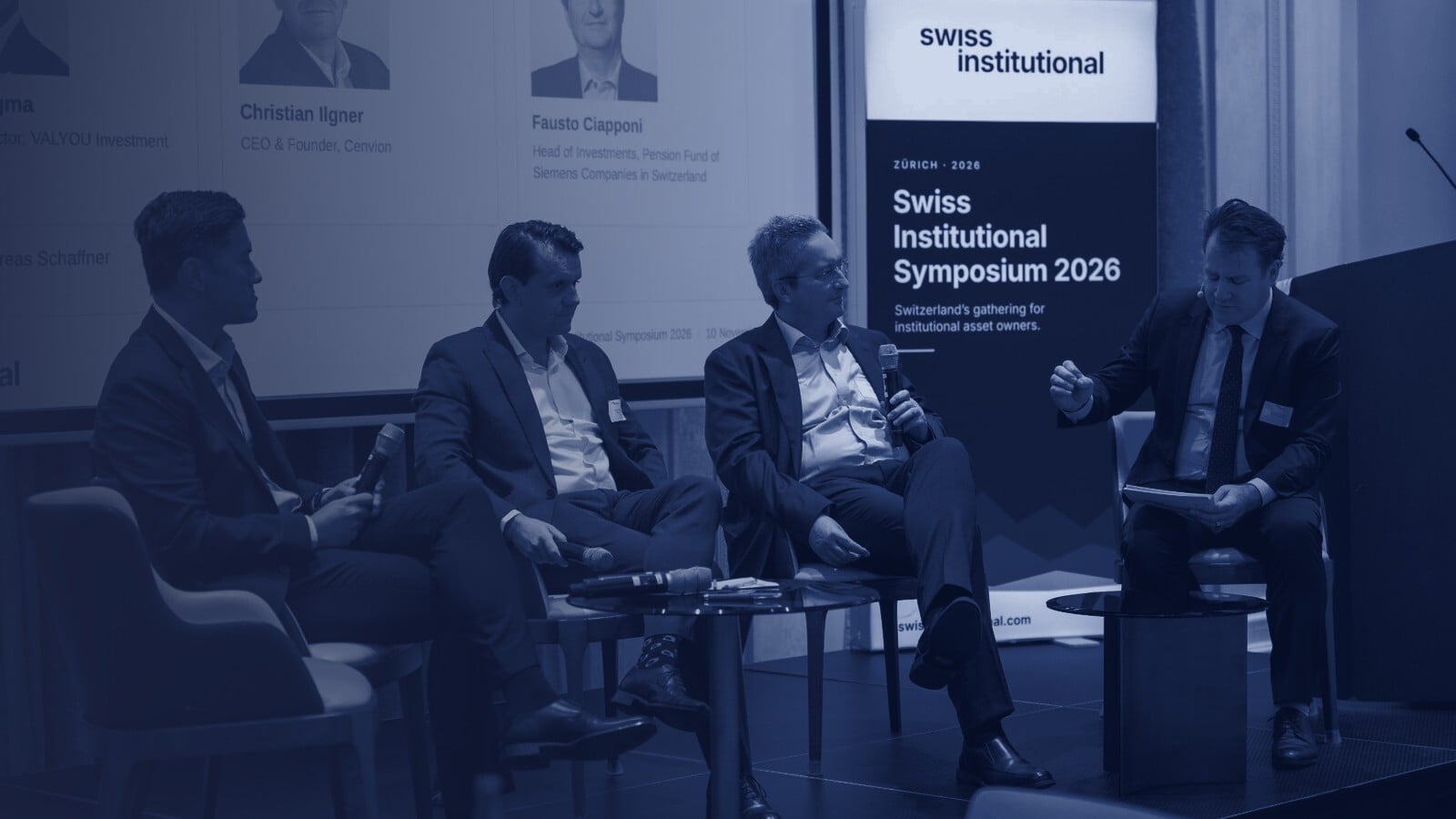
The case study was presented by Yonten Wagma, Managing Director, VALYOU Investment Foundation, and Christian Ilgner, Managing Director, Cenvion AG. The panel that followed was joined by Fausto Ciapponi, Head of Investments and Member of the Executive Board, Pension Fund of Siemens Companies in Switzerland. Moderated by Andreas Schaffner.
Note: Figures on VALYOU and Cenvion are taken from their presentations and are self-reported; returns have not been independently verified.
Case study VALYOU: Infrastructure starts with risk control
VALYOU Investment Foundation launched its infrastructure investment group in 2019. Today it comprises around 15 investments with assets of roughly EUR 90 million. Wagma began by describing the asset class. An energy storage system resembles real estate, because it is a real asset with a long useful life, but it does not necessarily have a contractually fixed rent. As in private equity, active management creates value, yet the asset is tied to a project and a grid connection. And as with bonds, the cost base and term are predictable, while revenues are variable.
From this he derived the foundation's core thesis: "Infrastructure does not begin with the asset, but with risk control." A project only becomes investable when four levels work at the same time: technology, market, contracts and governance. In practice, five criteria decide:
- Grid connection: secured capacity, connection costs, land leases matched to the asset's life.
- Technology: manufacturer guarantees, battery degradation, fire safety. Degradation feeds into the financial model.
- Market: balancing services or active trading. The more actively a battery is traded, the higher the depreciation the model must reflect.
- Structure: project company (SPV), financing, covenants, tax, and whether the project is bankable.
- Governance: control rights, standardised reporting, valuation and handling of conflicts of interest. VALYOU has had its valuation model reviewed by an auditor.
The Ingenbohl case
The first asset was Ingenbohl I in the canton of Schwyz, a stand-alone lithium-ion battery with 20 MW of power and 18 MWh of capacity, held by the foundation and in operation since 2021. So far, the battery has earned its revenue predominantly from balancing services, that is, from standing ready to stabilise the grid frequency, rather than from trading, which is expected to gain weight over time.
According to VALYOU, the battery has generated revenue of around CHF 35 million since commissioning. At the time it went live, Ingenbohl was Switzerland's largest battery storage system; larger ones have since followed.
From a single project to a platform
Building on this, VALYOU expanded: in 2022 to Finland (Kerava), in 2024 with Ingenbohl II (bringing its Swiss capacity to 28 MW) and an additional Finnish asset, and in 2025 with a 100 MW / 200 MWh project in Arzberg in the Bavarian district of Wunsiedel, plus two more facilities in Finland. In 2026 the foundation formed BESS Perlen AG, a joint venture with Perlen Industrieholding AG, where a 10 MW battery is due to start operating early next year.
One factor matters particularly to Wagma: long-standing partnerships. Contractual pre-emption rights give the foundation privileged access to attractive projects and secure a reliable deal flow over the long term, with partners who know and trust each other. Governance and reporting are standardised across all assets, and Cenvion operates them.
Around 80% of the portfolio is to be in the core portfolio: battery storage, renewables and flexibility with long-term cash flows from balancing services, arbitrage, power generation and tolling agreements. The remaining 20% form a satellite portfolio of infrastructure-related growth themes that follow the same logic: real assets in industries with structural demand that generate long-term, contractually secured income. The latest example is AI computing infrastructure, where the project company acquires the hardware directly, runs it on renewable energy and leases it long term to specialised cloud providers. This business case offers institutional investors a compelling complement to the core portfolio: demand for computing power is growing structurally, while the lease structure provides predictable cash flows.
For investors, VALYOU reports a net return above its long-term target since launch, at a cost level in line with a competitive market. Correlation with listed assets is low, which proved its worth in phases of market stress such as 2022. More than 20 Swiss pension funds are invested, ranging from company schemes to larger collective foundations. Wagma's conclusion in three sentences: the energy transition needs storage, artificial intelligence needs computing power and electricity, and pension funds need long-term, stable returns.
Case study Cenvion: Where a battery's revenues come from
Christian Ilgner began with the market backdrop. Renewables accounted for 47.5% of gross electricity consumption in the EU in 2024, almost three times the level of 2004. Wind and solar generate intermittently, adding volatility to the grid and, increasingly, leading to negative power prices. In 2025, Finland, Germany and Spain each recorded several hundred hours with negative day-ahead prices. In Spain, where the number has risen most sharply, the first half of 2026 alone already brought more such hours than all of the previous year. Anyone who charges a battery in these hours is paid to do so. In the base case, Europe is expected to reach around 400 GWh of installed battery capacity by 2029, roughly half of what the EU will need by 2030. Growth is driven by volatility and by steeply falling capital costs, which, as with solar PV before, have repeatedly halved within a few years.
In principle, a battery buys power when it is cheap and sells it when it is expensive. "Surprisingly, that is not where most of our revenue comes from," Ilgner said. In Switzerland and Germany, the bulk comes from grid services: the battery receives a fixed payment for holding capacity ready to stabilise the grid frequency, plus an energy payment when it is actually called upon. Over the next few years, the weight will shift towards trading. An optimizer continuously allocates capacity to the most lucrative market segment ("revenue stacking"), while Cenvion systematically analyses the results of the various optimizers, benchmarks them against each other and the market, and negotiates the best conditions for the portfolio in coordination with the owners.
Four structures: from rental to full merchant
For pension funds that see electricity trading as too risky, Ilgner stressed that they are not forced into full market exposure. As with conventional renewables, a battery can run fully merchant or be secured through a tolling agreement, under which the owner leases the battery to a utility or trader for a contractually fixed term of several years against a fixed annual fee. In between are hybrid forms with a fixed component or a revenue floor plus a share of the upside. The more secure the revenues, the more debt can be raised on better terms. Early movers have more revenue potential with full merchant exposure, but also more risk and less access to financing. The choice of structure is therefore "an investment decision, not a detail".
A storage project is set up like other infrastructure projects: a project company holds the asset and contracts with the construction firm (EPC), the manufacturer, maintenance, the grid operator and the optimizer. A long-term service agreement over 15 years sets out how much capacity will be available in which year. Cenvion acts as interface manager between these contracts and coordinates the technical interfaces so that all parties work together smoothly.
Battery storage, he said, is an operationally demanding asset class. It requires round-the-clock monitoring because of its technical complexity and the strict regulatory environment. For a renewables portfolio with merchant exposure, however, a battery is an effective diversifier: when many plants produce at the same time and prices fall, the battery benefits.
Panel: Why the Siemens pension fund is moving to a mandate
Fausto Ciapponi heads investments at the Pension Fund of Siemens Companies in Switzerland, which manages around CHF 3.7 billion for some 9,300 active members and pensioners. The fund uses infrastructure to put additional risk budget to good use. It suits a long-term investor, offers real assets and current income, and to some extent replaces the fund's large bond allocation, which yields little in Switzerland. Battery storage would be only one part of it; the goal is global diversification across all sectors.
Ciapponi described the fund's start as "a bit naive". It ran a classic fund selection and invested around half in renewables. What it learned was that it had underestimated the effort. "There are two of us in investments, plus one in the back office. The time needed to understand, monitor and steer the asset class is out of proportion for 3% of assets."
Asked by the moderator about the minus 3.3% in the infrastructure portfolio the previous year, Ciapponi pointed to currency effects, which the fund does not hedge in this asset class, and a weak year for renewables. A one-year view makes no sense for infrastructure, though. In the financial year just closed on 30 September, the fund achieved a gain of 6% across the asset class as a whole.
The consequence: "We are generalists, not specialists." Rather than turning to advisers, the Siemens pension fund will hand the asset class to a segregated mandate over the long term. Performance responsibility lies with the asset manager, while the fund keeps strategic decisions. "We still have our foot on the accelerator": if, for example, the fund needs more liquidity in the coming years, it eases off, and returns from its investments are not reinvested. "By managing the mandate's structure more actively and capitalising on opportunities, we aim to achieve a significantly higher return than would be possible through 'passive' fund selection."
Infrastructure fits no single box
For Yonten Wagma, the comparison with real estate, private equity and bonds means that infrastructure is a building block in its own right within the overall portfolio. Its role is for each pension fund to decide: inflation protection, diversification or active participation in the energy transition.
Asked how much of the return was owed to the pioneer phase, Wagma acknowledged that the early years contributed a good deal. VALYOU, however, has since repeated this success several times, across multiple jurisdictions and technologies. A further driver is the diversification effect: batteries benefit from volatility, which is typically highest in periods of market stress, and can therefore stabilise a portfolio when other asset classes come under pressure. Over the medium term he expects returns in the BESS segment in the range of high single digits to low double digits. Such phases of volatility are likely to recur: the more renewables are added, the more volatile the grid becomes, which further supports the business case.
How secure are the revenues?
Ingenbohl has run without fixed offtake contracts since 2021. Christian Ilgner acknowledged that competition among batteries is increasing, with strong build-out in Germany and Poland. But the share of renewables is growing even faster, reaching around 56% of gross electricity consumption in Germany in 2025, and the last few percentage points in particular add volatility. Full merchant exposure pays off mainly for early movers. The more competitive a market becomes, the more one should turn to tolling or at least build in a revenue floor.
Which structure suits a pension fund depends on its existing portfolio, Ilgner said. If a fund already holds a lot of renewables with merchant exposure or difficult offtake contracts, or baseload-type assets whose capture prices come under pressure whenever renewable output is high, a fully merchant battery offsets exactly those risks. If it has invested little so far, or holds projects with long-term offtake contracts and fixed feed-in tariffs, tolling is the better fit. Ciapponi added that within a mandate, current income – central for a pension fund – can be structured to produce the required cash flows. Battery storage fits well there; at the moment it is "the place to be".
Fees, conflicts of interest and the operator's role
Several parties, a complex structure: how do valuation, fees and conflicts of interest remain transparent? Wagma cited VALYOU's membership of KGAST, which commits it to cost transparency, a fee level in line with competitors, and the fact that management receives no performance fee. Only the optimizer is paid on a variable basis: the more revenue it generates, the more it earns.
Ilgner illustrated the role of an operating partner: if a battery fails, the optimizer can only report that it is unavailable. The cause may lie with the transformer, the battery manufacturer or the grid operator, each with its own contractual responsibilities. Cenvion analyses the root cause, coordinates all parties and restores availability quickly, supports the owners in asserting warranty and service claims, and plans maintenance so that revenue losses stay minimal.
Questions from the audience
Dr. Doris Röhl (Zurich City Pension Fund) asked what share of the renewables was secured through fixed offtake contracts (PPAs), since only these guarantee stable income. Ciapponi replied that the Siemens pension fund had not set the funds a PPA quota, but rather the annual cash yield it wanted. He estimated the secured share at around 60%. In the mandate this can be steered more precisely in future – another reason for the switch.
Another question addressed costs: how many basis points is the fund willing to give up for professionalisation? "None," said Ciapponi. The providers had convinced the fund that, despite an additional legal wrapper, a mandate would cost no more than selecting various funds. That requires a partner with enough market power to secure good prices. A further requirement is a certain minimum size for the mandate, usually from USD 100 million. It was a clear requirement: it must not cost more.
Outlook: Infrastructure in five years
Wagma referred to a study by the Lucerne University of Applied Sciences showing that smaller pension funds invest little or nothing in infrastructure, larger ones around 4%. He wants to encourage and guide smaller funds in particular. He also appealed to pension funds to give smaller and mid-sized providers a chance: they usually invest more locally, so a larger share of the investment and of the value creation stays local. Ilgner would like to see the permitted 10% allocation exhausted first and, over time, private markets rising towards 40% of portfolios – "a bit optimistic" within five years, he conceded. Ciapponi remained sober: the asset class will become established at the Siemens pension fund, and the allocation is rising to 5%. In the long run much depends on the interest rate cycle. "If Swiss bonds yielded five or seven percent, why would you do something as complicated as infrastructure?" With low rates, the asset class will keep growing.
Context for Swiss pension funds
Since 1 October 2020, infrastructure investments have formed a separate asset category under BVV 2 (Art. 53 para. 1 let. dbis BVV 2), limited to 10% of assets (Art. 55 let. f BVV 2). According to the Swisscanto Swiss Pension Fund Study 2026, pension funds hold around 2% in infrastructure on average. Battery storage is gaining ground quickly in Switzerland: according to Swissolar's Battery Monitor 2026, around 135 MWh of grid-side storage is in operation, with around 4,200 MWh planned by 2030. Since 2025, storage without end consumption no longer pays grid usage fees (Art. 14a of the Electricity Supply Act, StromVG). Access routes include funds, investment foundations, co-investments, direct holdings and segregated mandates; responsibility for the investment strategy always remains with the board of trustees. (Editorial context)
Conclusion
The case study showed what a well-structured battery storage asset can deliver, and the panel what it takes for a pension fund to benefit from it. What matters is less the technology than risk control, the right route-to-market structure and governance with clear responsibilities. The most open question came from the pension fund itself: how much complexity is an asset class worth once interest rates rise again? As long as they stay low, infrastructure is likely to gain further weight in portfolios.
This summary is based on the case study "Infrastructure: Battery Storage" with Yonten Wagma (VALYOU Investment Foundation) and Christian Ilgner (Cenvion AG) and the subsequent panel with Fausto Ciapponi (Pension Fund of Siemens Companies in Switzerland), Yonten Wagma and Christian Ilgner at the Swiss Institutional Symposium 2026, Mandarin Oriental, Zurich, 10 November 2026. Moderation: Andreas Schaffner. Statements from the German-language parts translated by the editors. Return figures are self-reported by the providers. This article does not constitute investment advice.